
HAeX - Professional AI Development Agency in UK
Custom AI Development Services Designed Around Your Goals
Custom AI development means building AI software around your specific business, rather than making do with a ready-made product that almost fits. HAeX provides AI development services to UK businesses when off-the-shelf software cannot do the job, from bespoke tools and integrations through to full applications, and we stay involved after launch. We begin by checking whether you need something custom at all, because frequently you do not, and we would rather tell you that than sell you a build.
- We check whether you need custom at all before quoting a build
- Built in stages, proving the risky part first
- Supported after launch, not handed over and forgotten

Most
Businesses that ask us about custom AI are better served by something off the shelf
1 risk
The riskiest assumption is what we build and test first, before the full project
Years
How long custom software has to keep working, which is what we build for
£0
Cost of your first scoping call, and of the readiness assessment
The wall every growing business hits
When “there is a tool for that” quietly stops being true
Most of the time there is a tool for that, and you should use it. Off-the-shelf software is cheaper, faster and far less risky than building your own, and any consultant worth listening to reaches for it first.
But you can usually tell when a business has outgrown that answer, because the symptoms are so familiar. There is a piece of software you pay for every month that everyone has a workaround for. There is a spreadsheet somewhere that started as a stopgap and is now quietly load-bearing, and one person understands it. There are two systems that both hold the same information and have no idea the other exists, so somebody keeps them in step by hand.
None of that looks like a crisis. It looks like normal friction, which is exactly why it goes unexamined for years. The real cost is hidden in the hours people spend bending around the software, the mistakes the workarounds let through, and the things you have quietly stopped attempting because the tooling makes them painful.
At that point you have two poor options and one good one. Keep bending your business around the tool and accept the drag forever. Bolt together a fragile workaround that breaks the moment anything changes. Or build the thing that actually fits, once, properly. Custom AI development is that third option. The skill is knowing when you have genuinely reached the wall, and when you just have not looked hard enough at what already exists.

Sound familiar?
You are probably here because one of these rings true

The tool that almost does it
You pay for software that handles most of what you need, except the one thing that matters most. Everyone has a workaround. The workaround has become the process.
The gap nobody sells a product for
Your process is specific enough that no vendor has built for it, or two of your systems need to talk and no ready-made connection exists. So a person is the connection.

An idea nobody has built yet
You can see something AI could do for your business, or for your customers, that does not exist on the market. The question is whether it is worth building, and what it would take.
All three are worth a conversation. Only some of them are worth a custom build, and we will tell you which yours is.
The question to settle first
Should you build custom AI, or buy something ready-made?
Most AI development companies will not ask you this, because the answer is often bad for them. It is the most important question you can settle before spending anything.
| Buy off the shelf when… | Build custom when… | |
|---|---|---|
| Fit | A product already does most of what you need | No product fits the thing that matters most |
| Your process | Is fairly standard for your industry | Is genuinely specific to how you work |
| Urgency and budget | You need it working quickly and cheaply | The problem is core enough to justify the investment |
| Competitive value | The task is common across many businesses | The capability would give you a real edge |
| Ongoing cost | You want someone else maintaining it | You accept that software needs looking after |
If the honest answer is “buy”, we will say so and tell you what to look for. We would rather earn your trust and your next project than sell you a build you did not need.
What we build
What custom AI development covers
Custom does not mean starting from nothing. It means building the right amount of bespoke software around proven AI, so you get something that fits without paying to reinvent the basics.
Bespoke AI tools
Software built around a specific task your business does, that no off-the-shelf product handles properly.
AI features in your own product
Adding AI capabilities to software you already own or sell, so it does more without a rebuild.
Custom integrations
Connecting AI, and your systems, where no ready-made connection exists and a person is currently the bridge.
Full AI applications
Complete applications built around an AI capability, whether for your team internally or for your customers.
Proof of concept and MVP
A small, working first version that proves the idea holds up before you commit to the full build.
Ongoing development & support
Software needs looking after, and AI software more than most. We stay involved so it keeps working.
Ways we build
Custom AI Development Services That Fits Your Business
Depending on what you need, a project usually starts as one of these. Each has its own page.
- 01 · Full builds
AI Software Development
Complete, supported software
Building AI software end to end to solve a specific business problem, from working out exactly what to build, through development and testing, to launch and ongoing support.
- Designed for real conditions, not tidy demos
- Built in stages so you can steer
- Supported after launch
- 02 · Language & content
Generative AI Development
The technology behind ChatGPT, applied
Building tools on generative AI that write, summarise, answer questions from your own material, and take on other language-heavy work, with the checks that make them trustworthy.
- Grounded in your own information
- Built to flag uncertainty, not guess
- Accurate enough to put in front of customers
Specific kinds of build
Three builds we are asked about most
These come up often enough to be worth explaining properly, because the terms get used loosely and the differences matter to what you spend.
LLM application development
Large language models are the technology behind modern AI assistants: the part that reads, understands and writes in plain language. LLM application development means building software around one of these models so it does something genuinely useful for your business, such as answering questions from your own documents, drafting tailored content, or pulling structured information out of messy text.
The model itself is the easy part, and it is not where projects fail. The work is in connecting it to your data properly, keeping its answers accurate, setting sensible limits, and making it behave predictably enough to rely on. That is what we build
Al Workflow Automation
An MVP, or minimum viable product, is a small, working first version of an idea built to prove it works before you commit to the whole thing. For AI projects this matters more than usual, because AI ideas are unusually good at looking brilliant in a demo and falling apart in practice.
So we build a focused MVP that tests the riskiest assumption first, not the easiest one. If the idea is going to fail, it fails cheaply and early, while you still have the budget to try something else. It is the least glamorous way to avoid an expensive mistake, and the most reliable.

Al Governance & Compliance
If your idea is a software product you intend to sell to customers, rather than use internally, that is AI SaaS development: building an AI-powered application that other people pay to use.
This carries requirements an internal tool never has. It must handle many customers at once, keep their data properly separated and secure, stay reliable as usage grows, and cost something predictable to run per customer. We build with those constraints in from the start, because retrofitting them once you have paying users is painful and expensive.
The path
How a custom build actually goes
1
Scope honestly
We work out whether you need custom software at all, and what precisely it must do.
2
Prove the risk
We build the riskiest part first, usually as an MVP, so the idea is tested cheaply.
3
Build the rest
With the risk settled, we build the full thing in stages you can see and steer.
4
Launch and support
It goes live and we stay involved, keeping it accurate and reliable as things change.
What to expect
What working with us looks like
Scoping call
You describe the problem. We tell you honestly whether it needs custom software, whether an existing tool would do, and roughly what a build would take.
- Free · 30 mins
Discovery and design
We work out exactly what to build and, just as importantly, what to leave out. Scope discipline here is what keeps a project affordable and finishable.
- Discovery
Prove the riskiest part
We build and test the assumption most likely to sink the project, so you learn early whether the idea holds up.
- First build
Build in stages
The full build proceeds in visible stages rather than one long silence, so you can steer as it takes shape.
- Main build
Launch and support
We put it live and stay involved, because software nobody maintains slowly stops working, and AI software drifts faster than most.
- Launch
How we can work together
Three ways to engage us
Fixed project
A defined build for a defined price, agreed up front after scoping. Best when the requirement is clear.
Retained team
Ongoing development capacity for larger or evolving work, where the requirement will keep developing.
Staff augmentation
If what you actually need is people on your own team rather than an agency, we can help you hire them.
Built to last
The technology we build with
We build with proven, well-supported technology rather than whatever launched last month, because software you depend on has to keep working for years. Depending on the project that means AI models from providers such as OpenAI, Anthropic and Google, established languages and frameworks, and secure, reliable hosting, connected to the systems you already run rather than replacing them. Where a project genuinely needs something at the frontier we will use it, and we will explain plainly why the extra risk is worth taking.
No hidden day rates
What custom AI development costs
Every project is fixed-price and agreed up front after a free scoping call. The cheapest project we can sell you is the one you do not need, and we will point that out before you spend.
Custom work varies more than our other services, so we scope every project individually. Here is the shape of it.
Proof of concept or MVP
- the affordable way to test an idea
A full custom build
- scoped to what you need
Retained development capacity
- monthly, scoped to your roadmap
If an off-the-shelf tool would do
- we will tell you
First scoping call & readiness assessment
- free
Why HAeX
Built by people who know what “finished” actually means
Plenty of AI development companies will happily build you custom software. Fewer will tell you when you do not need it, and fewer still are around to support it eighteen months later when your data has shifted and the model underneath has changed twice.
HAeX started on the talent side of AI. Having placed more than 200 AI specialists into UK businesses, we have watched a lot of custom projects up close, and the pattern is consistent. The hard part is never the first version. It is everything after: keeping it accurate, keeping it reliable, and keeping it maintained while the ground moves. So we build with that in mind from the first design decision, and we stay involved.
It also means we are honest about the alternatives. If an existing product would solve your problem for a fraction of the cost, we will name it. If what you really need is a permanent developer on your own team, we can help you find one instead.
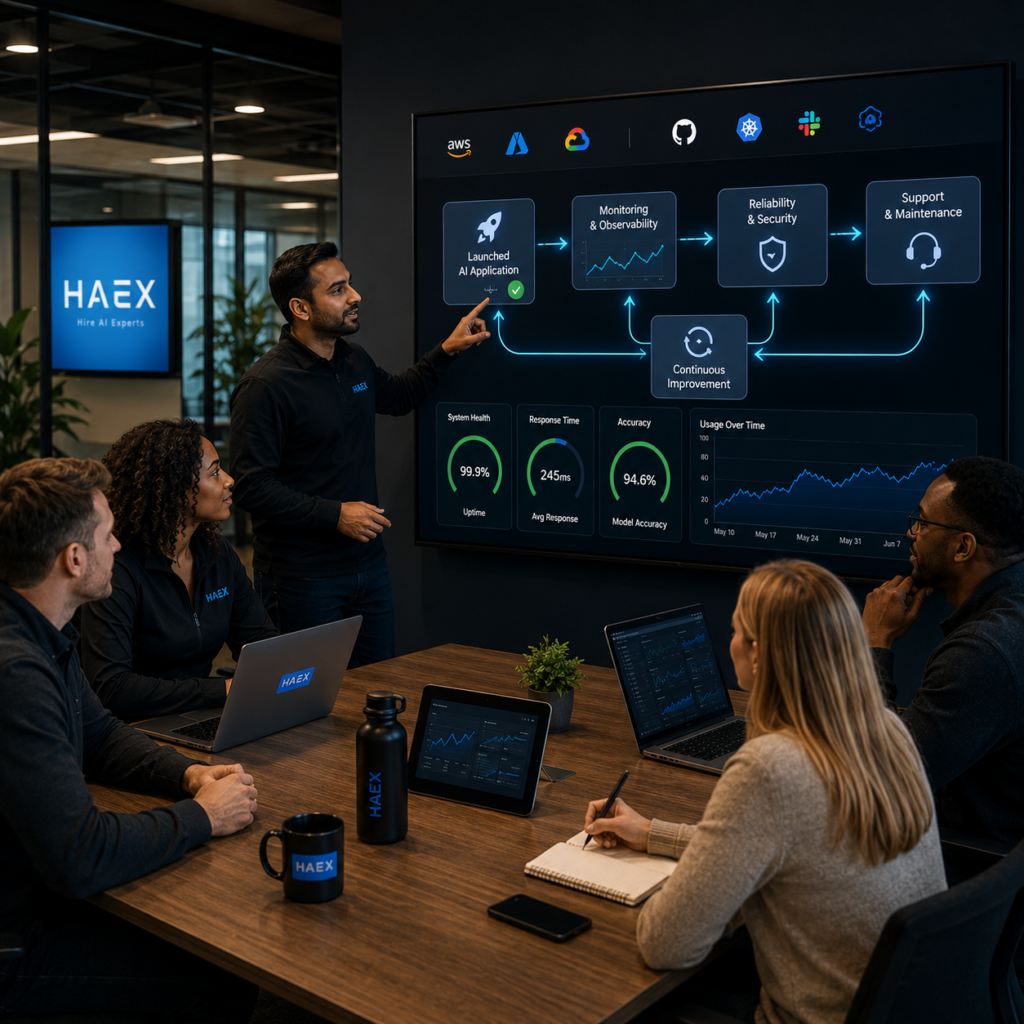
Build versus buy answered honestly, before we quote anything.
Built to last, on proven technology rather than the newest thing.
Riskiest part proven first, so failures are cheap and early.
Supported after launch, because that is where software actually lives.
Due diligence
Questions to ask any AI development company, including us
The right-hand column is simply how we answer them, and why businesses end up choosing us.
| Ask them… | The common answer | The HAeX answer |
|---|---|---|
| Do we actually need custom software? | Rarely asked, since the answer risks the sale | We settle it first, and often the answer is no. |
| What do you build first? | Whatever is easiest to demonstrate | The riskiest assumption, so problems surface while they are cheap. |
| What happens after launch? | Support is a separate conversation, later | We stay involved, because AI software drifts if nobody maintains it. |
| Who actually writes the code? | Unclear, often subcontracted | The team who designed it, and you will know who they are. |
| What if the idea does not work? | You find out at the end | You find out in the first stage, before the main budget is committed. |
| What does it cost? | “It depends, let’s talk.” | Fixed price, agreed up front after a free scoping call. |
Shaped around your sector
Built around your industry
- Healthcare
Bespoke tools that fit clinical and administrative workflows, with information governance designed in from the first conversation rather than added at the end.
- Financial services
Custom software scoped to sit within FCA expectations, from client-facing tools to internal systems, with auditability considered up front.
- Retail & e-commerce
Custom AI for the parts of your operation no standard platform understands, particularly where your process is genuinely your own.
- Manufacturing
Bespoke tools for the specific processes and data that generic software was never designed to handle.
Not listed? The approach is the same. Book a call and we will apply it to your sector.
A quiet checklist
If three of these sound familiar, custom is worth exploring
- There is software you pay for that everyone has a workaround for
- Two of your systems hold the same information and a person keeps them in step
- You can describe exactly what you need, and no vendor sells it
- You have an idea for your customers that does not exist on the market
- A spreadsheet has quietly become load-bearing, and one person understands it
- You have stopped attempting things because the tooling makes them painful
- A previous AI project produced a good demo and nothing more
Client words
What working with HAeX feels like
Honestly answered
Frequently asked questions
Custom AI development is building AI software designed around a specific business, instead of using a ready-made product. It covers bespoke tools, AI features inside your own product, custom integrations and full applications. It is the right choice when off-the-shelf software cannot handle the thing that matters most. Good custom development still builds on proven AI rather than reinventing it from scratch.
For most businesses, most of the time, buy. Off-the-shelf tools are cheaper, faster and less risky. Custom is worth it when no product fits the specific thing you need, when the problem is core to how your business works, or when a custom capability would give you a genuine advantage. We settle this question before quoting anything, and we will tell you when buying is the better call.
Custom work varies more than our other services, so we scope each project after a free call. The most affordable way to start is almost always a small proof of concept or MVP that tests the idea before the full build. A complete custom application is a larger, staged investment. We will always flag if a cheaper off-the-shelf option would do the job.
Often, yes, and it is one of the most common things we do. Adding AI features to an existing product or system usually costs far less than a rebuild, because you keep everything that already works. A free scoping call will tell you whether it is practical for your particular software.
An MVP is a small, working first version built to prove an idea before you invest in the whole thing. For AI it is especially valuable, because AI ideas can look excellent in a demo and fail in real use. Building an MVP first tests the riskiest assumption cheaply, so if the idea is not going to work you find out early, while you still have budget to try something else.
Yes. Software nobody maintains slowly stops working, and AI software drifts faster than most because the data and the models underneath it change. We stay involved after launch to keep what we build accurate, reliable and current, rather than handing it over and disappearing.
Two things keep it under control. First, scope discipline in discovery: deciding what to leave out matters as much as deciding what to build. Second, building in visible stages with the riskiest part proven first, so nothing important is discovered late. Projects overrun when the hard part is left until the end, so we do the opposite.
Find out whether you really need custom AI
Book a free 30-minute call. Describe the problem no existing tool quite solves. We will tell you honestly whether it needs custom software, what building it would take, and whether something cheaper would do the job instead. That last answer is free, and it is often the useful one.